
Union Parish Multi-Day Arrest Records
UPSO publishes no multi-day arrest log online. There is no 72-hour booking page, weekly sheriff blotter, or searchable jail archive either. The Louisiana Commission on Law Enforcement roster directory lists Union Parish's local VINE deployment as offline. Those are web-access facts only. Booking files still exist at the agencies. Plenty of people get arrested in Union Parish during any given span.
The Gazette offers the clearest publication pattern. Historical weekly issues carried sections titled "UNION PARISH ARRESTS," sometimes alongside a separate Farmerville Police Department list. Its current web archive runs on events rather than a full weekly ledger. KNOE publishes selected agency-based stories. The Banner News serves the Bernice area with a weekly print rhythm. None of these outlets is the jail, the Sheriff, the Clerk, or the court.
Read Union Parish Arrest Coverage
A newspaper archive works best as an index, not a custody database. Work backward by date. Then trace each claim to the agency named in the story. A Sheriff release, a city police statement, and a detention-center record may each tell part of the same story. Each one covers a different piece. The Clerk becomes key once formal charges exist.
- Search the Gazette news archive by date, town, agency, or event. Note whether the item is a current web story or an older weekly issue.
- Read the source attribution. UPSO, Farmerville PD, Bernice PD, and Marion PD do not share one municipal blotter.
- Write down the alleged charge and publication date, but do not assume either equals the booking date or final charge.
- Confirm current custody with UPDC and request the initial report from the arresting agency.
- Use Union Parish Clerk criminal records to find the later formal charge and disposition when a case has been filed.
The Gazette news archive anchors most Union Parish arrest reporting.
Always check each story against the originating office.
Union Arrest-Log Entry Fields
Union Parish has no official web blotter schema. The fields below separate what a news item may report from what the official booking summary keeps. Newspapers stay selective. Agencies and courts hold the records worth verifying.
| Entry detail | How to interpret it |
|---|---|
| Name | Check spelling and identity against the official record, especially when names are common. |
| Publication date | Not necessarily the arrest or booking date. |
| Agency | Shows who supplied or created information; it may differ from the jail operator. |
| Charge | An charge reported at that stage, subject to reduction, dismissal, or another court result. |
| Event account | Often drawn from an agency statement and not the complete investigative file. |
| Image | May be agency-supplied or editorial. It is not guaranteed to be a UPDC booking photograph. |
Louisiana article 228 sets the official booking baseline. It calls for the legal name if known, the charge, the arresting person, a short account of events, and the booking date and time. Later Clerk records may add a bill of information, a plea, a dismissal, or an acquittal. Treat no first report as the last word. The file keeps growing after the newspaper moves on.
Read the source line closely. When a story credits UPSO, the Sheriff's records custodian is the logical place for the report. A story naming Farmerville, Bernice, or Marion police points to that municipal department for the initial incident report. UPDC answers custody questions at the parish detention center. One caution applies. A town name in a headline may mark where the event happened or where the person lives, not which agency made the arrest.
Photos need the same care. The Gazette or a television station may run an agency-supplied image, a file photo, or another editorial picture. None of those is automatically a UPDC booking photograph. Booking photos online come through the Sheriff's app, its FAQ says. The newspaper promises no image with each report. Let the caption and source context decide what a picture actually shows.
Union Weekend Arrest Reporting
Nothing official supports a weekend surge or a Monday posting schedule in Union Parish. The Gazette's old weekly format never guaranteed every arrest. Its current web posts appear as stories warrant. The Banner News section mails weekly but posts no complete booking ledger. KNOE covers selected events. Routine intake goes unreported.
Holiday timing is undocumented too. Never assume a Friday arrest surfaces in a Monday roundup. A date-range request removes that guesswork. Ask the arresting agency for the initial report and booking information covering your exact dates. The Police Jury runs the jail, so detention records go through UPDC, and Sheriff-held reports go through UPSO Records.
Local coverage adds context. It is not an official or complete arrest log, though. For a booking possibly made today, one page helps. The Arrests Last 24 Hours page explains the current app and UPDC verification route. That same-day task differs from digging through several days of agency and news records.
Union Arrest Archives and Retention
How long do Union Parish arrest records stay online? The public pages never say. Louisiana R.S. 44:36 sets a floor instead. Public records must be kept at least three years when no other period or approved schedule applies. That is preservation law, though. It does not keep a booking photo visible online.
An older-record search should start with the office that made the file. UPSO Records holds Sheriff reports. Jail-system records may sit with UPDC or the Police Jury. A municipal department keeps its own incident report. Ask each office for the record-series name, the retention schedule that applies, and whether the item was transferred or lawfully destroyed. For the court side, the Union Parish Clerk's Criminal Department carries the file, and its current Clerk Connect or COTT E-Search link opens the docket.
Put your request in writing. Include the person's full name. Add the approximate arrest and booking dates, the town, the arresting agency, and any case number. Say exactly what you want: a booking list for a date span, an individual booking summary, an initial report, or a booking photograph. UPSO asks for a name, phone number, date, location, and report type. Its estimate is five business days once that information is complete.
Older arrest material may follow a different trail. Louisiana's State Archives explains that agencies use approved retention schedules and need approval before disposal. Its program helps identify how a record series is managed. It cannot confirm that Union Parish jail photos went to a state repository. So start local. Ask UPSO, UPDC, or the Police Jury for the schedule governing the series, its date span, and whether the record stayed, moved, or was destroyed under authority.
Note: Newspaper preservation, an agency retention schedule, and continued app display are separate questions with different custodians.
Unofficial Union Arrest Archives
Only one aggregator has a Union Parish section. That is Mugshots.com. Its directory leans historical, organized by older year links. No dependable current-booking schedule appears there. Treat it as an unofficial historical lead, not an agency record. BustedNewspaper, RecentlyBooked, Arrests.org, and Mugshots.zone list no current Union Parish section. The Union Parish directory on Mugshots.com should be read with its age and unofficial status in view.
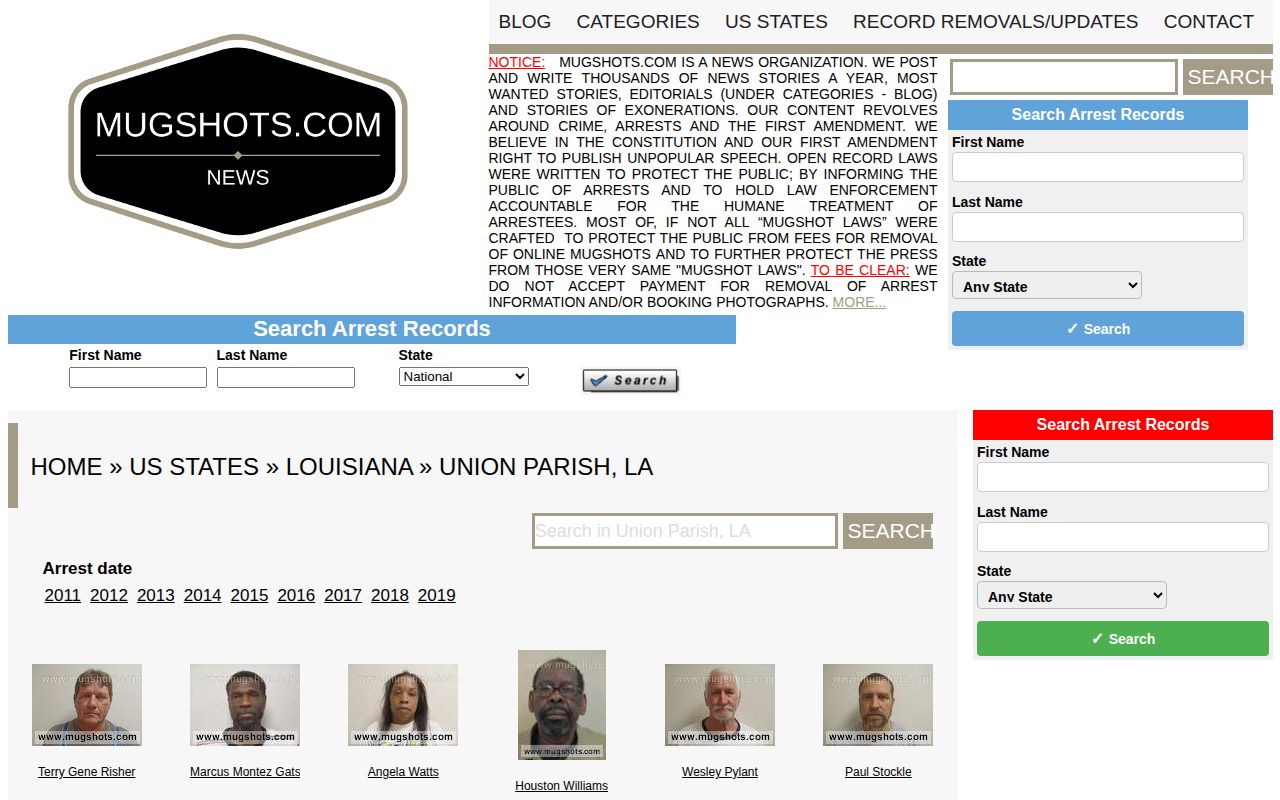
Third-party pages have real limits. They can be late, incomplete, duplicated, or simply wrong. An old entry can also omit a later, favorable outcome. Confirm anything with the originating agency and the Clerk.
The Gazette's historical print sections and the aggregator directory play different roles. The paper records a community-news practice. It sometimes separates Farmerville Police Department arrests from broader parish material. The aggregator collects older entries with no official authority. Neither covers the full multi-day range an agency date request can seek. KNOE and other regional stations add event coverage, usually when a case seems newsworthy, but routine bookings go unreported.
Read archive dates with care. A weekly issue date may follow the arrest date. A web update can land after first publication. Record both dates when tracing an item. Then compare them with the booking date, the filing date, and any Clerk minute entry. That timeline keeps a later article or recycled historical page from masquerading as a new Union Parish arrest.
Request Union Arrest Records by Date
A tailored records request beats a news search for a full multi-day span. The official UPSO Records page gathers it all. It lists records@unionsheriff.com, (318) 608-3017, fax (318) 368-7817, mail, and walk-in access at 710 Holder Road in Farmerville. Name your exact dates. Ask about that range. Does the office hold a booking list, arrest report, or booking summary for it?
The jail is governed separately. That can affect where a request goes. Booking-system data may belong to UPDC rather than a deputy's report. Ask UPDC or the Police Jury to name the custodian. Custody questions go to (318) 368-9827. A city officer's arrest means that city police department holds the originating report.
The Clerk's verified minutes are the best local bridge. 'Disposition' means how the court resolved or last acted on the charge. A release from jail is only a custody event. A dismissal, plea, acquittal, or conviction is a case event instead. The Union Parish recent-arrests hub maps those official record layers in full.